PIPEDA vs HIPAA: A Healthcare Guide 2026
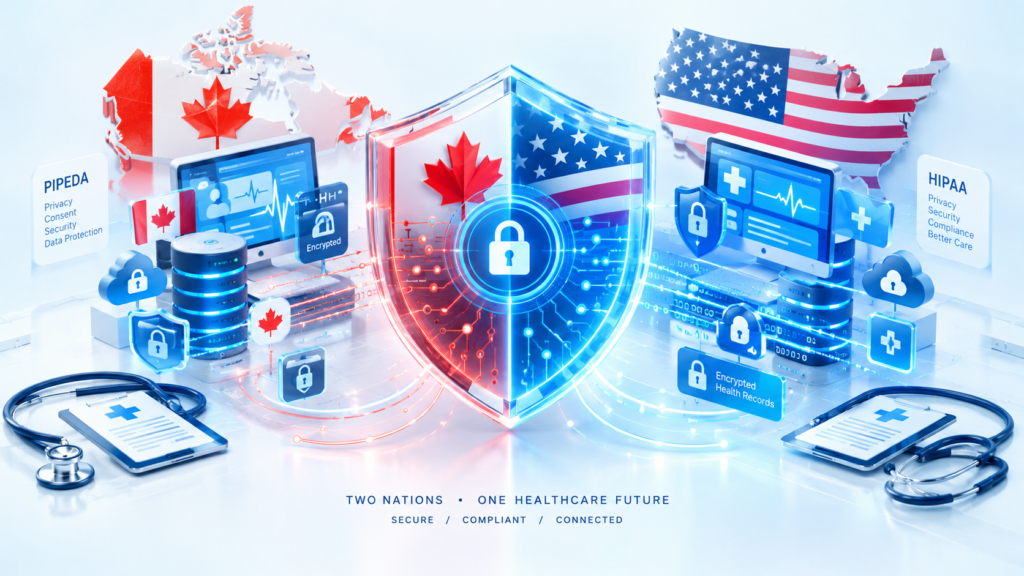
PIPEDA vs HIPAA: What Is the Difference?
The simplest way to understand the difference is:
PIPEDA protects personal information in commercial activities, while HIPAA protects specific health information handled by covered entities and business associates.
PIPEDA is Canada’s federal private-sector privacy framework. It applies to organizations engaged in commercial activities and establishes principles covering accountability, consent, purpose limitation, safeguards, transparency, access, and accuracy.
However, PIPEDA does not automatically apply to every Canadian healthcare organization. Provincial privacy laws may apply instead or alongside it.
For example, Ontario has the Personal Health Information Protection Act (PHIPA), Alberta has the Health Information Act (HIA), and Quebec has its own comprehensive private-sector privacy framework.
HIPAA, by contrast, is a U.S. federal healthcare law. Its major components include:
- Privacy Rule: Governs uses and disclosures of PHI.
- Security Rule: Establishes safeguards for electronic PHI.
- Breach Notification Rule: Establishes requirements following certain breaches.
- Enforcement Rule: Provides mechanisms for investigations and penalties.
HIPAA generally applies to covered entities, including certain healthcare providers, health plans, and healthcare clearinghouses, as well as business associates that handle PHI for covered entities.
PIPEDA vs HIPAA at a Glance
| Area | PIPEDA | HIPAA |
| Type of law | General private-sector privacy law | Healthcare-specific privacy/security law |
| Primary jurisdiction | Canada | United States |
| Who it covers | Commercial organizations, subject to provincial exceptions | Covered entities and business associates |
| Protected data | Personal information | Protected Health Information (PHI) |
| Consent | Meaningful consent is central | Authorization generally required for uses outside permitted purposes |
| Security | Principle-based safeguards | Administrative, physical, and technical safeguards |
| Breach threshold | Real Risk of Significant Harm (RROSH) | Unauthorized access/use/disclosure of unsecured PHI unless low probability of compromise |
| Main regulator | Office of the Privacy Commissioner of Canada | HHS Office for Civil Rights |
| Vendor contracts | Accountability and contractual safeguards | Business Associate Agreement (BAA) |
| Cloud hosting | Permitted with appropriate safeguards | Permitted with appropriate safeguards and generally a BAA |
Is PIPEDA the Canadian Equivalent of HIPAA?
Not exactly.
This is one of the most common misconceptions about Canadian healthcare privacy.
PIPEDA is actually broader in scope because it applies to personal information rather than only health information. At the same time, it does not cover Canada’s entire publicly funded healthcare system.
For healthcare organizations, provincial health privacy laws are often closer to HIPAA in function.
For example, an Ontario healthcare organization may need to comply primarily with PHIPA, while a healthcare organization in Alberta may fall under the HIA.
Therefore, a Canadian organization should never assume that “PIPEDA compliance” automatically means it has satisfied all applicable healthcare privacy requirements.
How Do PIPEDA and HIPAA Protect Health Information?
PIPEDA and Personal Health Information
PIPEDA treats health information as sensitive personal information.
Because of that sensitivity, organizations are generally expected to use stronger safeguards and obtain meaningful consent for collecting, using, or disclosing health information.
Key principles include:
- Purpose limitation
- Data minimization
- Meaningful consent
- Appropriate security safeguards
- Accountability for third-party processors
- Transparency
- Individual access and correction rights
PIPEDA is relatively principle-based. Organizations must determine what safeguards are appropriate based on the sensitivity and circumstances of the information.
HIPAA and Protected Health Information
HIPAA protects PHI, or individually identifiable health information held or transmitted by a covered entity or business associate.
PHI can include:
- Diagnoses
- Medical records
- Treatment information
- Prescription information
- Billing information
- Health insurance information
- Patient identifiers
- Certain biometric identifiers
HIPAA also establishes the minimum necessary standard, meaning organizations generally should limit uses and disclosures to the minimum PHI needed for the purpose, subject to important exceptions such as treatment.
PIPEDA vs HIPAA Consent Requirements
Consent is one of the biggest operational differences between the two frameworks.
What Is Consent Under PIPEDA?
PIPEDA emphasizes meaningful consent.
Individuals should understand:
- What information is being collected
- Why it is being collected
- How it will be used
- Who may receive it
- The potential risks associated with the processing
Because health information is highly sensitive, express consent is generally the safer approach.
Organizations should avoid burying important information inside lengthy privacy policies. Layered notices, clear explanations, and separate choices for optional uses can make consent more meaningful.
Optimize your patient portals. Create intuitive, privacy-first patient experiences and transparent consent workflows with our secure Website Designing Services.
How Does HIPAA Authorization Work?
HIPAA allows covered entities to use and disclose PHI for certain core healthcare functions, including:
- Treatment
- Payment
- Healthcare operations
These are commonly referred to as TPO.
A formal authorization is generally required for uses outside permitted purposes, including many marketing activities, certain sales of PHI, and most uses of psychotherapy notes.
This creates an important distinction:
PIPEDA starts from consent, while HIPAA permits certain healthcare uses without patient authorization.
For a healthtech company serving both countries, consent and authorization workflows should therefore be designed with both regulatory environments in mind.
What Rights Do Patients Have Under PIPEDA and HIPAA?
Both frameworks give individuals important rights concerning their information.
PIPEDA Patient Privacy Rights
Individuals generally have rights to:
- Access personal information
- Request corrections
- Understand how information is used
- Know certain disclosures
- Withdraw consent, subject to applicable limitations
- Challenge an organization’s privacy practices
- File complaints with the organization or privacy regulator
Under PIPEDA, organizations generally have 30 days to respond to access requests, with certain extensions available.
HIPAA Patient Rights
HIPAA provides rights including:
- Access to PHI
- Requests for amendment
- Certain accounting of disclosures
- Requests for restrictions
- Confidential communications
- Receipt of a Notice of Privacy Practices
- Complaints to the covered entity or HHS
HIPAA generally requires access requests to be handled within 30 calendar days, with a permitted extension under certain circumstances.
The important takeaway is that patient access should be treated as an operational workflow—not something addressed only when a patient complains.
Make compliance easy to understand. Transform lengthy privacy policies into clear, accessible visual notices for your patients with our professional Graphic Designing Services.
PIPEDA vs HIPAA Security Requirements
Both frameworks expect organizations to protect health information, but HIPAA provides more detailed security requirements.
PIPEDA Security Safeguards
PIPEDA requires safeguards appropriate to the sensitivity of the information.
These can include:
- Physical security controls
- Organizational policies
- Employee training
- Access restrictions
- Password controls
- Encryption
- Monitoring
- Vendor safeguards
The principle-based nature of PIPEDA gives organizations flexibility, but it also requires them to demonstrate why their security measures are appropriate.
HIPAA Security Rule
HIPAA’s Security Rule requires covered entities and business associates to implement administrative, physical, and technical safeguards for ePHI.
Important controls include:
- Risk analysis
- Risk management
- Access controls
- Audit controls
- Authentication
- Integrity controls
- Transmission security
- Workforce security
Managing workforce access is critical to compliance. Streamline employee training tracking, role-based access, and onboarding with a modern HR System designed for healthcare organizations - Contingency planning
Security Controls That Support Both Frameworks
A cross-border healthcare organization should consider implementing:
- Encryption at rest and in transit
- Multi-factor authentication
- Role-based access controls
- Unique user accounts
- Centralized audit logging
- Regular access reviews
- Security awareness training
- Incident response procedures
- Backup and disaster recovery
- Vendor risk management
These controls can create a common security foundation for both Canadian and U.S. operations.
Strengthen your internal security posture. Equip your staff with the knowledge to maintain these critical safeguards through our IT Audit Controls Training Services.
PIPEDA vs HIPAA Breach Notification Requirements
Breach response is another major area of difference.
PIPEDA Breach Notification
Under PIPEDA, organizations must assess whether a breach creates a Real Risk of Significant Harm (RROSH).
If the threshold is met, the organization must generally:
- Report the breach to the Office of the Privacy Commissioner of Canada.
- Notify affected individuals.
- Notify other organizations or government institutions when doing so could reduce the risk of harm.
Organizations must also maintain records of breaches, including those that do not meet the reporting threshold.
Health information is highly sensitive, so it may weigh heavily in a RROSH assessment.
HIPAA Breach Notification
HIPAA generally presumes that an impermissible use or disclosure of unsecured PHI is a breach unless the organization demonstrates a low probability that the PHI was compromised.
The assessment considers factors such as:
- The type of PHI involved
- Who received or accessed it
- Whether the information was actually viewed
- Whether the risk was mitigated
For reportable breaches, affected individuals generally must be notified without unreasonable delay and no later than 60 calendar days after discovery.
Breaches affecting 500 or more individuals are also reported to HHS and publicly listed.
PIPEDA vs HIPAA Cloud Compliance
Cloud computing is permitted under both frameworks, but healthcare organizations must manage their responsibilities carefully.
Can Canadian Healthcare Data Be Stored in the Cloud?
Yes.
PIPEDA does not generally prohibit cloud hosting or require all data to remain physically located in Canada.
However, organizations remain accountable for personal information transferred to service providers. Contracts and other safeguards should ensure an appropriate level of protection.
Provincial requirements may impose additional considerations.
Can HIPAA Data Be Stored in the Cloud?
Yes, but organizations must establish appropriate contractual and security arrangements.
A cloud service provider that handles ePHI for a covered entity generally qualifies as a business associate, meaning a Business Associate Agreement (BAA) is required.
Organizations should verify exactly which cloud services are covered by the provider’s BAA.
What Should You Check in a Healthcare Cloud Provider?
Consider:
- BAA availability
- Data processing agreements
- Encryption
- Key management
- Access controls
- Audit logging
- Security certifications
- Data residency options
- Breach notification commitments
- Subprocessor transparency
- Secure deletion procedures
Remember that cloud security is a shared responsibility. A secure cloud platform cannot compensate for insecure application configurations, excessive permissions, or exposed credentials.
PIPEDA vs HIPAA Cross-Border Data Transfers
Cross-border processing is especially important for companies operating between Canada and the United States.
Canadian personal information can generally be transferred to another country for processing, but organizations remain accountable for the information and should be transparent about international processing.
Organizations should document:
- What information crosses borders
- Where it goes
- Why it is transferred
- Which vendors receive it
- What safeguards protect it
- Who can access it
Provincial laws can add additional requirements. Quebec, for example, has specific privacy impact assessment requirements involving certain transfers outside the province.
For U.S. healthcare data, HIPAA does not impose a blanket prohibition on offshore processing. However, contractual requirements, state laws, customer requirements, and federal program rules can affect whether international processing is acceptable.
PIPEDA vs HIPAA Vendor and SaaS Requirements
Vendor management is critical because healthcare organizations rarely control every system that touches patient information.
HIPAA Business Associates
A HIPAA business associate may include:
- Cloud providers
- Billing companies
- EHR vendors
- IT providers
- Transcription services
- Certain professional service providers
A covered entity generally needs a BAA before a business associate handles PHI.
PIPEDA Third-Party Vendors
PIPEDA does not use the same “business associate” terminology.
Instead, the organization remains accountable for personal information transferred to third parties for processing and should use contractual or other measures to provide comparable protection.
A strong vendor assessment should examine:
- Security controls
- Data location
- Subprocessors
- Incident response
- Contractual restrictions
- Data retention
- Data deletion
- AI and secondary data use
This is particularly important for analytics and AI vendors.
PIPEDA vs HIPAA for Telehealth Platforms
Telehealth providers need to consider privacy throughout the entire patient journey.
Important safeguards include:
- Secure video communication
- Strong authentication
- Encrypted messaging
- Secure document sharing
- Minimal information collection
- Secure recording policies
- Privacy notices
- Third-party integration reviews
For U.S. providers subject to HIPAA, the telehealth platform should support HIPAA requirements and provide an appropriate BAA.
Canadian telehealth providers may need to consider PIPEDA, provincial health privacy legislation, and professional regulatory requirements depending on their structure and jurisdiction.
Building a new telehealth solution? Launch secure, compliant, and scalable platforms tailored to your clinical workflows with our Custom Business Application Development Services.
PIPEDA vs HIPAA for AI and Healthcare Technology
AI creates additional privacy risks because healthcare organizations may want to use large datasets for model training, analytics, automation, and decision support.
AI Under PIPEDA
PIPEDA is technology-neutral. If an AI system collects, uses, or discloses personal information in commercial activity, privacy obligations still apply.
Organizations should consider:
- Purpose limitation
- Consent
- Transparency
- Accuracy
- Data minimization
- Security
- Accountability
AI Under HIPAA
If an AI vendor processes PHI for a covered entity, HIPAA obligations can apply and the vendor may qualify as a business associate.
Healthcare organizations should avoid putting identifiable patient information into general-purpose AI systems without appropriate contractual and privacy protections.
Before using patient information for AI training, ask:
- Do we have legal authority to use the data?
- Can the dataset be de-identified?
- Does the vendor retain the data?
- Is the vendor allowed to train models using it?
- Where is processing performed?
- Who can access the dataset?
- How is re-identification risk controlled?
PIPEDA vs HIPAA Penalties and Enforcement
HIPAA generally carries more significant federal financial penalties than PIPEDA.
HIPAA enforcement is led primarily by the HHS Office for Civil Rights, while criminal matters can involve the Department of Justice.
PIPEDA is overseen by the Office of the Privacy Commissioner of Canada (OPC). The OPC investigates complaints and compliance issues and can take matters to Federal Court.
PIPEDA’s federal penalty structure differs substantially from HIPAA’s civil monetary penalty system. However, organizations must also consider provincial Canadian privacy laws, which can impose significant administrative and financial penalties.
Therefore, comparing only PIPEDA and HIPAA fines can be misleading. A Canadian healthcare organization may face substantial obligations under provincial legislation even where PIPEDA itself is not the primary framework.
PIPEDA vs Provincial Healthcare Privacy Laws
Canadian healthcare privacy compliance is not simply a PIPEDA-versus-HIPAA comparison.
Organizations must first determine which Canadian law applies.
Ontario
Ontario healthcare organizations may fall under PHIPA, particularly where they operate as health information custodians or agents.
Alberta
Healthcare organizations may need to consider the Health Information Act, while private-sector organizations outside its scope may be subject to Alberta’s private-sector privacy legislation.
British Columbia
Private organizations and public-sector organizations operate under different privacy frameworks, making the organization’s role particularly important.
Quebec
Quebec has particularly comprehensive private-sector privacy requirements, including privacy impact assessments, transparency requirements, and rules affecting international data transfers and automated decision-making.
The right compliance question is therefore not simply:
“Are we PIPEDA compliant?”
Instead ask:
“Which Canadian privacy laws apply to our organization, our customers, our data, and our specific activities?”
How Can a Healthtech Company Comply With Both PIPEDA and HIPAA?
A healthtech company serving both markets should build a unified privacy and security program rather than maintaining two completely separate systems.
1. Map Your Data
Identify:
- What health data you collect
- Where it comes from
- Where it is stored
- Who can access it
Centralizing patient billing and supply chain data? Ensure your enterprise software handles sensitive data securely from day one with our ERP Implementation Advisory Services. - Which vendors process it
- Where it crosses borders
2. Determine Applicable Laws
Map requirements based on:
- Patient location
- Customer location
- Customer type
- Data type
- Business model
- Province
- State
- Cross-border activity
3. Build Strong Common Security Controls
Implement:
- Encryption
- MFA
- Role-based access
- Logging
- Monitoring
- Secure backups
- Incident response
- Vendor risk management
4. Standardize Contracts
Use appropriate:
- BAAs
- Data processing agreements
- Confidentiality provisions
- Subprocessor requirements
- Security schedules
- Breach notification clauses
5. Create a Unified Incident Response Plan
Your incident response process should identify which regulatory pathway applies to each incident.
For example, a single breach may require different assessments under PIPEDA, provincial Canadian laws, HIPAA, and U.S. state breach laws.
6. Maintain Compliance Evidence
Keep documentation such as:
- Risk assessments
- Privacy impact assessments
- Policies
- Training records
- Access reviews
- Vendor assessments
- Incident records
- Consent records
Good documentation can be just as important as the underlying technical controls.
PIPEDA vs HIPAA Compliance Checklist for 2026
PIPEDA and Canadian Healthcare Checklist
- Determine whether PIPEDA or provincial legislation applies.
- Identify a privacy officer or responsible privacy lead.
- Document collection purposes.
- Obtain meaningful consent where required.
- Minimize data collection.
- Implement appropriate safeguards.
- Maintain a clear privacy policy.
- Establish access and correction procedures.
- Review third-party contracts.
- Document cross-border processing.
- Establish a breach assessment process.
- Report qualifying breaches when required.
- Maintain breach records.
- Monitor Canadian privacy law developments.
HIPAA Checklist
- Determine whether your organization is a covered entity or business associate.
- Complete a thorough security risk analysis.
- Implement administrative, physical, and technical safeguards.
- Establish appropriate BAAs.
- Control access to PHI.
- Enable audit logging.
- Encrypt sensitive information.
- Train employees.
- Establish incident response procedures.
- Implement backup and disaster recovery.
- Maintain required documentation.
- Establish patient access and amendment workflows.
- Review vendors and subprocessors regularly.
Final Takeaway: PIPEDA vs HIPAA
PIPEDA and HIPAA share the same broad goal—protecting sensitive information—but they are not interchangeable laws.
PIPEDA is a broader, principle-based Canadian privacy framework focused on personal information in commercial activities. HIPAA is a U.S. healthcare-specific framework focused on PHI handled by covered entities and business associates.
The most important differences involve:
- Scope
- Consent
- Patient rights
- Security requirements
- Breach notification
- Vendor contracts
- Cloud computing
- Cross-border data
- Provincial and state requirements
- Enforcement and penalties
For a healthcare or healthtech company operating in both countries, the safest strategy is not to choose between PIPEDA and HIPAA. Instead, build a unified privacy and security architecture that maps requirements across both frameworks and then adds province- and state-specific controls where necessary.
Start with data mapping, privacy-by-design, strong access controls, encryption, vendor management, documented risk assessments, and a tested incident response process.
Most importantly, determine which laws actually apply to your specific organization and data flows before assuming that compliance with one framework automatically satisfies the other.
For cross-border healthcare businesses, privacy compliance is not simply a legal checkbox. It is part of building patient trust, reducing security risk, shortening enterprise sales cycles, and creating a healthcare platform that can scale responsibly across North American markets.
Need expert guidance? Ensure your healthtech platform meets all North American privacy regulations with our comprehensive Healthcare IT Compliance Assurance Services.